Hands-on tower dissections help students connect computer hardware to real-world computing systems
Students at the Aerospace Academy of the Eastern Shore (AAES) took a deep dive into the inner workings of computers this week through a hands-on computer tower dissection lab led by Christopher Matthews at Arcadia High School, with support from AAES STEM Specialist Joy Phillips.
Working in small teams across four sites spanning more than 60 miles, students carefully opened desktop computer towers and identified major hardware components by sight and structure. As they examined motherboards, CPUs, RAM, power supplies, storage drives, cooling systems, and expansion cards, students practiced using precise technical vocabulary and made observations about how each part is designed and physically organized.
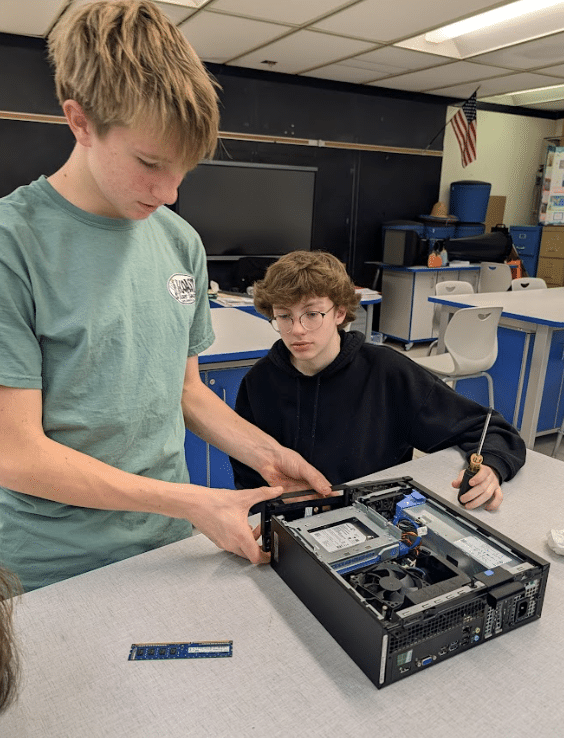
Throughout the lab, students approached the activity like engineers, asking critical questions such as what each component does, how it can be identified, and why it is designed the way it is. This inquiry-based approach helped students move beyond surface-level recognition to a deeper understanding of computer architecture.
After identifying the components, students connected what they observed inside the tower to how a computer functions as a complete system. They explained the role each part plays and traced how data and power move through the machine to enable computing. By linking hardware components to software performance, students explored how programs depend on processing, memory, and storage to operate effectively.
The experience provided a strong foundation for future learning in computer science, troubleshooting, and technology-related fields that support the broader aerospace ecosystem. Through hands-on exploration and collaborative problem-solving, AAES students gained practical insight into the systems that power modern technology.