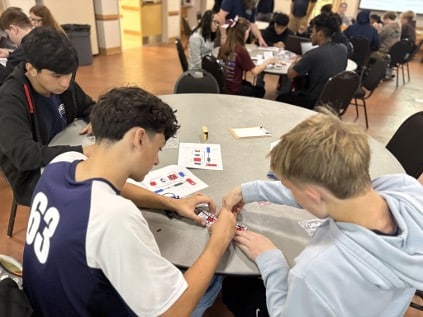
The Aerospace Academy of the Eastern Shore (AAES) ninth-grade students built a STELLA-Q2 device in teams and collected preliminary spectral data. The STELLA-Q2 is designed for classroom accessibility (connector-based, no soldering) and includes multiple spectrometer sensors that measure irradiance in the visible to near-infrared range, making it an ideal entry point for students new to scientific instrumentation and data collection. The workshop was hosted at the Eastern Shore Community College and led by Michael Taylor, STELLA team lead from NASA Goddard Landsat mission. The AAES students celebrated the moment their devices “came to life,” and the build process intentionally reinforced productive struggle—requiring careful assembly, debugging, and iteration as they learned to trust both the engineering process and the data.

NASA’s STELLA (Science and Technology Education for Land/Life Assessment) instruments. STELLA is an open-source, low-cost suite of DIY instruments (including student-build spectrometers) that introduces learners to the same Earth-observation concepts used in NASA missions—connecting local measurements to satellite-based remote sensing and analysis.
Looking ahead, AAES plans to scale STELLA across the full four-year program as a student-built toolset for authentic, place-based investigations on the Eastern Shore—where coastal ecosystems, agriculture, and NASA Wallops’ aerospace context create a powerful living laboratory. Over time, students will use STELLA to connect field measurements to NASA Earth observation datasets (e.g., Landsat) and apply remote sensing to real questions, building the quantitative, technical, and analytical skills that translate directly to aerospace and geospatial careers.
Planned applications at AAES include:
- Coastal & wetland monitoring: vegetation health and change detection in marsh systems
- Agriculture & land management: crop/plant reflectance patterns and seasonal trends
- Student-designed investigations: hypothesis-driven field studies that pair STELLA readings with satellite imagery and mapped results
- Future expansion into aerial data collection: exploring how lightweight STELLA instruments can support UAV-enabled investigations as students’ skills mature
To learn more about how you could implement STELLA in your schools, visit their website at STELLA – STELLA.